
Elektronik Yayın
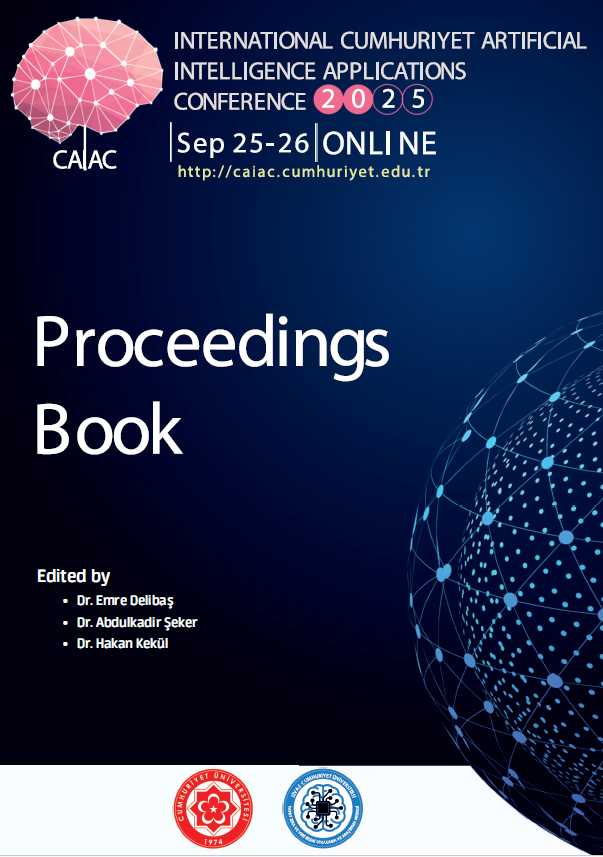
Caiac’25: The Proceedings Of The International Cumhuriyet Artificial Intelligence Applications Conference 2025
STOKTA
100 adet
50.00 ₺
Yayın Bilgileri
Yayın Yılı:
2025
ISBN:
978-625-6497-69-6
Yayın Tipi:
Dijital
Dil:
İngilizce
Yayınevi:
Cumhuriyet Üniversitesi Yayınları
Baskı Bilgisi:
1. Baskı
Sayfa Sayısı:
147 sayfa
Yayın Hakkında
The CAIAC'2025 Proceedings Book is a comprehensive scientific compilation that brings together current research conducted in the fields of artificial intelligence, data science, computer engineering, and interdisciplinary information technology applications. A total of 17 original papers were presented by academics, researchers, graduate students, and industry professionals from various universities in Turkey and research institutions around the world. These papers reflected the scientific diversity and versatility of the conference. The studies encompass a broad spectrum of subjects, including machine learning, deep learning, natural language processing, sentiment analysis, bioinformatics, educational technologies, simulation and modeling, decision support systems, classification methods, and artificial intelligence-based health applications. This diversity presents a valuable opportunity to conduct a thorough examination of the rapidly evolving and transformative impact of artificial intelligence across various scientific disciplines. A primary objective of the CAIAC series is to promote knowledge exchange by fostering robust interaction between academic and industry sectors. In this context, all papers included in the booklet have undergone a double-blind peer review process based on criteria such as scientific originality, methodological consistency, contribution to the field, and applicability. Only research that met high scientific standards was selected. The theme of this year's conference initiated a series of discussions concerning the role of artificial intelligence in individual and organizational transformation, expectations for future technologies, and the ethical, technical, and social dimensions of artificial intelligence solutions. In this context, the papers include both methodological innovations at the theoretical level and applied solutions to real-world problems. This booklet is not only an academic output of CAIAC 2025, but also serves as a reference source for researchers. This compilation is expected to stimulate future scientific studies and encourage new developments in the field of artificial intelligence. Additionally, it is designed to foster a sustainable collaborative environment within the research community.
Aynı Kategoriden Diğer Yayınlar
STOKTA YOK
50.00 ₺
STOKTA YOK
50.00 ₺
STOKTA YOK
50.00 ₺